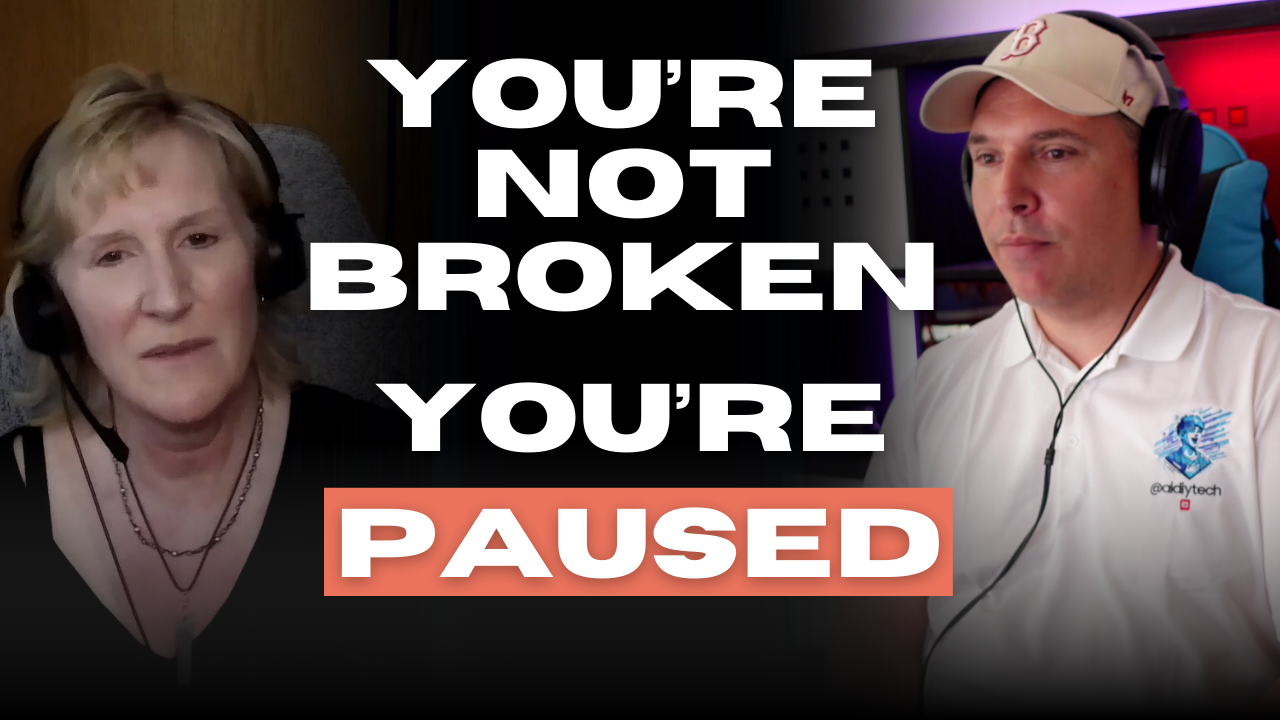
Interview with Briana Hoffman | AIDIY Episode Recap
"I wasn’t creating because I didn’t care. I wasn’t creating because I felt everything—and it became too much."— Briana Hoffman
🎥 Watch the Full Interview
🧭 Why This Episode Matters
When I sat down with Briana Hoffman, I thought we were going to talk about AI music, writing, and maybe some creative process tips.
What we ended up with was something bigger: a deeply personal, raw, and honest exploration of what it means to be an empath in a hyper-noisy world—and how tools like AI aren't just for speeding things up… they might be the very thing that slows us down enough to hear ourselves again.
This was a full hour-long conversation, and I’ll be honest—I didn’t want to cut it short. We went deep into:
- Grief and emotional shutdown
- The paralysis of overstimulation
- The power of returning to creative practices
- Why AI is helping empaths feel seen and make again
- And how sensitivity isn’t weakness—it’s a creative superpower
This one is for the empaths. The over feelers. The creatives who’ve gone quiet. The writers who stopped writing. The musicians who hear the melodies but can’t quite reach them.
🎵 “Hold Me” – An original song by Briana Hoffman
🔍 Key Moments & Takeaways
💔 1. When Everything Feels Like Too Much
Briana opens up about the raw truth of living as an empath—not as a trend, but as a reality. When the world gets loud, fast, and relentless, sensitive people often shut down—not because they don’t care, but because they care too much.
She explains the sensation of being overwhelmed by everything all at once—and how that emotional static can silence even the most seasoned creatives.
✍️ 2. The Writer Who Stopped Writing
For years, writing was Briana’s way of making sense of the world. But after losing her partner and facing an ocean of grief, that creative outlet went dark.
She talks about what that silence felt like—not just writer’s block, but soul block. And she shares how terrifying and isolating it is when the thing that used to save you suddenly vanishes.
🤖 3. AI Didn’t Replace Her Voice—It Helped Her Find It Again
Here’s where it gets really interesting: Briana started playing with AI tools like ChatGPT and Suno not as a tech experiment—but as a creative lifeline.
She describes how AI helped her get unstuck, reframe inner thoughts, and collaborate with something non-judgmental. It became a co-writer, a mirror, a sounding board—and in some ways, a gentle nudge to return to herself.
This is exactly why AIDIY exists: not to dehumanize creativity, but to augment it—especially for those of us who’ve lost touch with our spark.
🎶 4. Turning Emotion Into Music
Even if you’re not a songwriter, this section will move you. Briana explains how AI tools let her experiment with melody and emotion in ways she never thought possible.
She didn’t need to be a classically trained musician. She just needed a space where her feelings could move—and AI gave her that sandbox.
It’s a powerful reminder that music doesn’t need to be polished to be potent. It just needs to be felt.
🧘♀️ 5. Empaths Are the Antenna of the Human Race
We talk about the idea that empaths often pick up on emotional signals before others even notice them. They carry the emotional frequency of rooms, relationships, and culture.
That’s not a curse—it’s a calling. And with the right tools, it can be a creative advantage.
AI isn’t here to drown that sensitivity—it’s here to help empaths express it in ways that are scalable, shareable, and resonant with others.
💬 My Takeaway as Host
This conversation stayed with me long after we hit “stop recording.”
I’ve talked to plenty of tech-forward creators. But Briana brought something else: soul.She didn’t speak in bullet points. She spoke in open wounds, healing threads, and unedited truth.
That’s what we need more of—not just in AI music, but in the entire creative world.
If you’re an empath… if you’ve ever thought “I’m too sensitive for this,” or “I’m just not built for today’s pace,” this conversation is your permission slip.
You don’t need to be loud. You don’t need to be fast. You don’t need to be perfect.
You just need to create from where you actually are—and AI can help you do that, one keystroke, lyric, or prompt at a time.
Music is for everyone. I run the AiDIY lives, the Featured Five and this little corner of the internet where AI music creators hang out.